By Jacob Harver
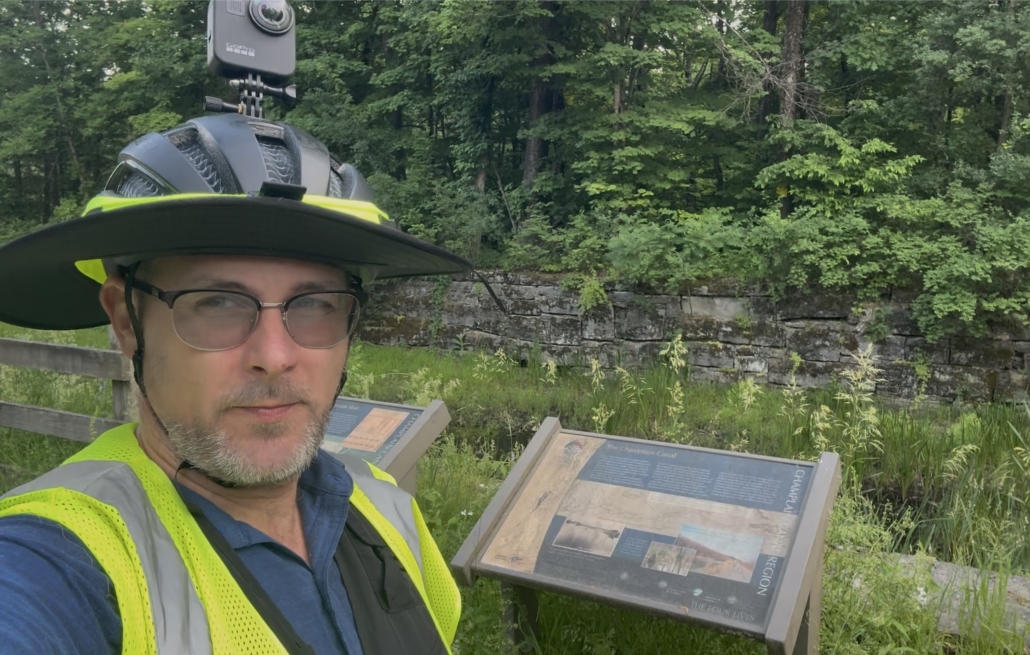
Combining my passion for long-distance bicycle trips, with a fascination for a barge canal that was never built, and a belief that both are factors to understand deindustrialization and the politics of our time, I biked from Albany to the 2026 DePOT conference in Montréal. The title of the presentation I gave was “It is easier to bicycle between Youngstown and Montréal than it is to boat.” Having biked the towpath of the Erie Canal in 2022, and multiple times from Youngstown, Ohio to Lake Erie, I felt justified in having tested the hypothesis. However, while trudging up and down the Adirondack Mountains, I was less certain of the conclusion. Nevertheless, I made it and would not change a thing about the experience and conference (besides needing more hydration between Fort Ann and Ticonderoga, New York).
Had I boated between Albany and Montréal, it would have been relatively smooth sailing thanks to the Champlain and Chambly Canals. Yet, physically experiencing the rough terrain laid bare why it has been so consequential in the shaping of empires, including the Haudenosaunee, French, British, and the United States. Along the way, historical markers told a story I only knew remotely, along with new items that significantly altered my perspective. Though I try to be a good academic in reading monographs, I must confess my favorite way to learn history is in situ from public interpretation panels. It is what inspires my mission to connect Youngstown to the emerging North American interpreted active transportation trail network.
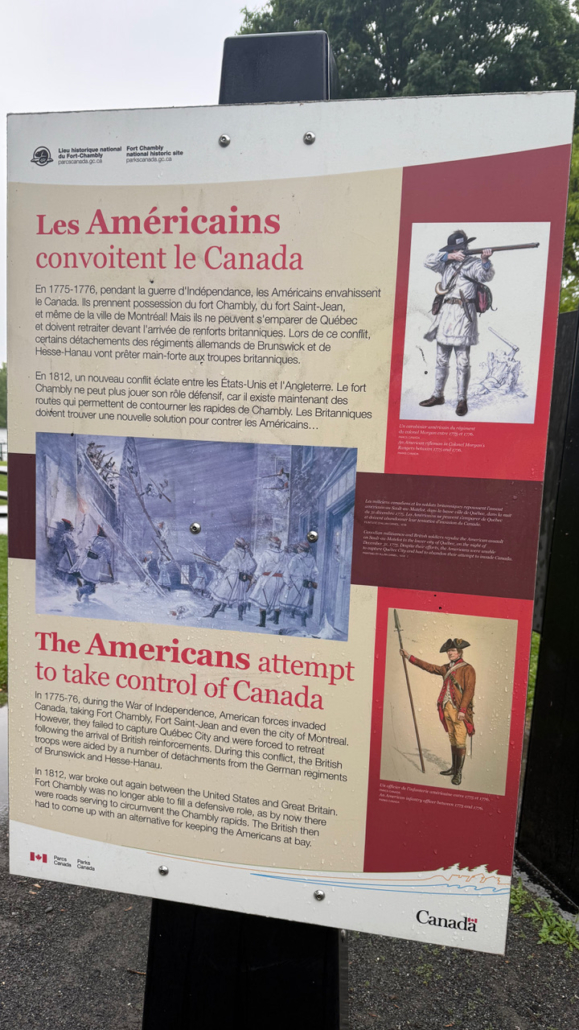
In contemplating the politics of our time, tracing the route of the 1775, 1812, and 1814 invasions of Québec by the United States took on greater meaning. While the natural borders were all too real, the man-made border between the U.S. and Canada was more Kafkaesque, though luckily I did not have any trouble going through. Not too far into Québec, I came to the Lacolle Mills Blockhouse, where a small band of Canadian militia with Mohawk and Algonquin allies held off the larger U.S. force in 1812 and defended again with British regulars in 1814. Making my way to the Richelieu River, at Fort Chambly were the most extensive historical markers describing the 1775 invasion by the Continental Army, which captured the fort, then Montréal, but were ultimately repelled in the battle at Québec City.
Arriving in Montréal, as has been my experience with all DePOT events, the conference was extremely informative, hospitable, and accessible. The presentations by participants from around the world, including India, Chile, Slovenia, Italy, and Scotland, were amazing, but especially thanks to the home-court presence of the Canadian contingent, it helped garner a comparative and shared North American perspective. Reconnecting with scholars such as William Gillies, Fred Burrill, Lauren Laframboise, Liam Devitt, and Graham Latham meant I learned just as much outside the official sessions as in them. Of course, the highlight of the trip was getting a tour of the Lachine Canal from the maestro himself, Stephen High, whose Deindustrializing Montreal is a great model for my own dissertation on a neighborhood shaped by transportation in Youngstown, OH.
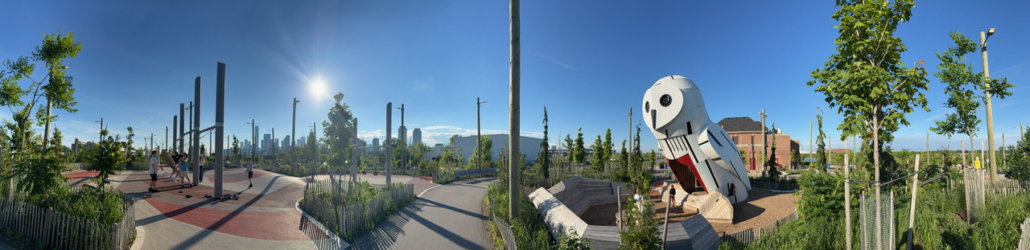
One of the presentations at the Summer Institute was by Seana Irvine titled, “Redeveloping Toronto’s Post-Industrial Port Lands: Decolonization perspectives and opportunities.” Irvine covered the process from the scientific to cultural in the reclamation of a former industrial zone as a park and environmentally restored space, critically with First Peoples’ perspectives and input finally being included. So I had to see it on the way back home (by the luxury of automobile). The site did not disappoint, and along with reading Tom Fraser’s Invested in Crisis, meant I got to know Ontario better on this trip as well. Fraser’s work also opened my eyes to the process of pension fund capitalism going on in my own state’s institutions.
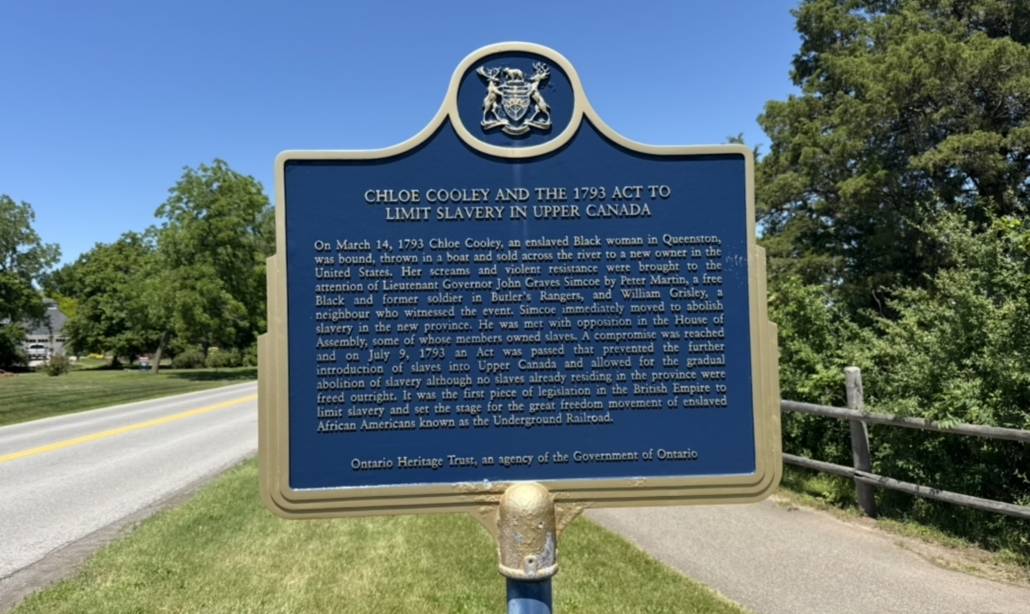
Finally, before crossing back over into the United States, I drove along the Niagara River from across where I left it biking the Erie Canal in 2022. Between the falls and Lake Ontario, I came upon another historical marker with a remarkable story that shaped freedom in North America. In 1793, Chloe Cooley, a woman in Queenston, Ontario, held in bondage by a Loyalist originally from New York, was beaten, bound, and boated across the river to be sold in the United States. The uproar, thanks to the advocacy of a nearby free Black resident, a witnessing neighbor, and the Lieutenant Governor, ultimately led to the abolition of slavery in Upper Canada. According to the marker, “It was the first piece of legislation in the British Empire to limit slavery and set the stage for the great freedom movement of enslaved African Americans known as the Underground Railroad.”
One of my favorite concepts is schismogenesis, the idea that two neighboring societies purposefully define their identities in contrast to each other, as described in Graeber and Wengrow’s The Dawn of Everything. I wonder if that moment in the tragedy of Chloe Cooley, a schismogenic was born. Over the nineteenth century, it moved southward into the United States as the self-liberation of enslaved peoples and the advocacy of their abolitionist allies forced a war to end slavery. Contemplating this marker and the “Voices of Freedom” memorial in Niagara-on-the-Lake brought full circle the Underground Railroad historical panels along the Western Reserve Greenway in Ashtabula County between Youngstown and Lake Erie. These panels describe the arduous path north to freedom in Canada, as well as the 1859 southward march as John Brown organized rebellion after meeting Harriet Tubman in St. Catharines, Ontario, then setting up camp in Ashtabula County, Ohio. His band was joined by Dangerfield Newby, a blacksmith in the county who had escaped enslavement in Virginia but was returning to free his wife and children.
From the schismogenesis that lasted between Cooley to Juneteenth, it is incomparable and unfathomable that such an elemental human rights struggle and victory could grow out of the current turbulence of the Trump administration’s actions toward the U.S.’s closest neighbor, ally, and trade partner. However, the networks that connect us, along with the constructive dialog and scholarship spearheaded by DePOT, are essential in transcending the negative human and environmental costs that industrial and deindustrial policies and the politics of our time have wrought.