
The Italian word capannone describes a single-storey industrial building that can be put up quickly using low-quality materials. These industrial sheds are the architectural hallmark of Italy’s areas of small and medium-sized industry. They have become the symbol of a bustling but atomised system of production, bland and impersonal, that has devoured and disfigured the beautiful rural landscape.
Unlike the great factories, with their thick brick walls and tall, elegant chimneys, these buildings have never inspired modernist or nostalgic images. The landscape of the capannoni has never had its own Bernd and Hilla Becher.
But in Porto Marghera, Venice’s port district, once a major industrial hub, one capannone has earned itself a capital C. The Capannone looks much like all the others: an unremarkable building whose exterior gives no hint of what makes it different, or of the treasure it holds inside [image 2].
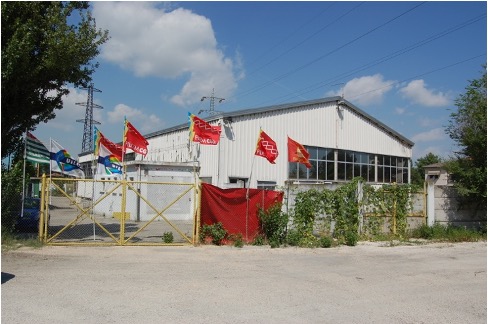
It was built in the early 1970s, after a law won through fierce collective struggles gave workers the right to hold assemblies during paid working hours. At the time, Porto Marghera’s factories employed 40,000 workers. Large as they were, none had room for gatherings on that scale. Built right next to the petrochemical complex’s canteen, the Capannone immediately became a tangible, physical expression of “workers’ power”, eclipsing the historic but somewhat stuffy party and union premises in the topographies of class.
Since then, the Capannone has served as the working class’s capitol, agora and temple. It has hosted countless, often stormy assemblies of shop stewards and activists: at one point, so the story goes, the chairs were bolted to the floor to stop them from being thrown. National party leaders, mayors, MPs, ministers, academics and even a president of the Republic have passed through its doors. In 1979, the Patriarch of Venice held the funeral there for three laboratory technicians who died in agony when a cylinder of hydrofluoric acid exploded. It has also hosted concerts and plays. In 1974, an avant-garde staging of Othello delighted the workers but scandalised the critics, who deemed it unsuitable for a working-class audience and, above all, complained about having to make their way to “a bare industrial shed amid the flames and fumes of Marghera”.
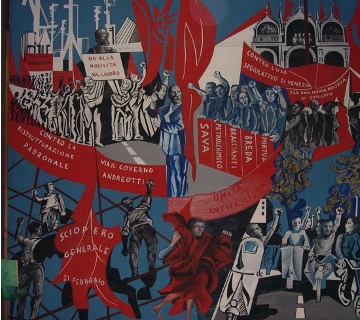
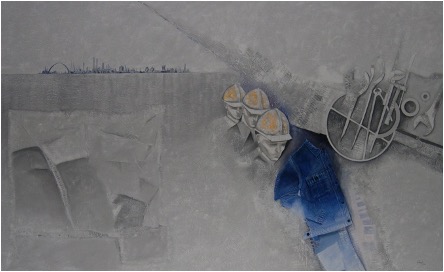
Over the decades, the Capannone has become anything but bare. It has filled with works by artist-activists and worker-artists, and served as a creative workshop for workers’ self-representations and scenographies of their protests. The artworks it houses tell an unintended history of deindustrialisation: from its beginnings in the 1970s — with a vast painting by the Venetian artist Vittorio Basaglia, showing workers taking the offensive against “capitalist restructuring” (1973) [image 2] — to the last canvas by the worker-painter Bruno Garlandi (2003). In it, a worker in blue overalls stands alone, fading into the grey of the Venetian lagoon, drowning along with his tools, his history and material culture [image 3].
That year, the nylon plant was shut down, setting off a domino effect of closures that has now seen petrochemical production disappear altogether. War, death and toxicity recur in the other works collected over the years, alongside images of reconciliation between humanity and nature through work: this would have been the only alternative to closing down one of the country’s most polluting industrial complexes.
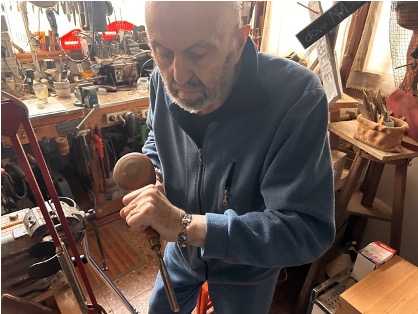
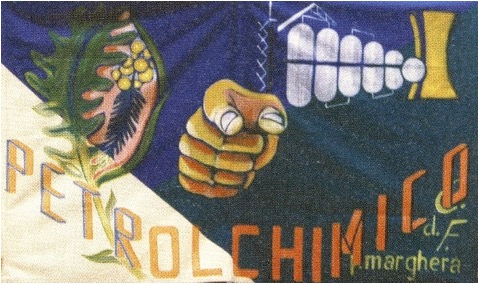
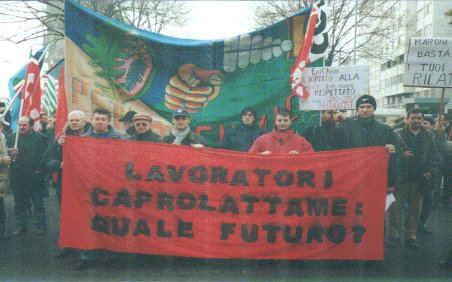
Besides the paintings, the Capannone preserves banners and other artefacts of struggle, conceived collectively and then carried through the city’s streets during demonstrations and strikes against industrial crises and job cuts. The master behind these creations is Augusto Cucciniello, an instrument technician at the petrochemical complex and a self-taught wood sculptor [image 4].
A recurring motif in his banners is the fist, but when I interviewed him recently, he was keen to stress that this is not a raised communist fist: it punches horizontally through space, embodying workers’ strength and unity beyond ideologies. Such is the power of this symbol that his most beautiful banner depicts a fist with six fingers, framed by the natural, feminine motif of mimosa and the familiar outlines of the industrial landscape [image 5-6].
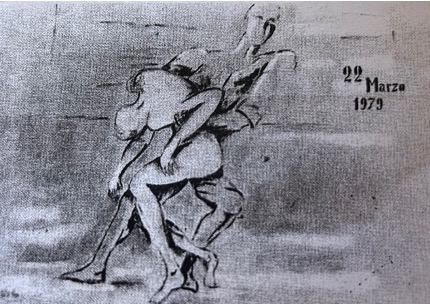
Soon after the hydrofluoric acid accident in 1979, Cucciniello also painted an outdoor mural—now completely faded — depicting two naked bodies entwined. It was meant to preserve forever the memory of those who came to the aid of workers burned by the acid, a supreme act of courage and humanity. A triumph, then, of compassion rather than death. Although nothing in the mural suggests it, Augusto told me that the figure he had in mind was Joseph of Arimathea, the disciple who, according to the New Testament, laid Christ’s body in the tomb [image 7].
Symbolic syncretism, political and religious repertoires, and an eclectic mix of techniques and styles sit side by side, without hierarchy, in the museum the Capannone has become — a museum with no curators and no plan. Yet it is precisely its evolution into a museum of working-class history that the unions contest. In 2022, the last remaining part of the petrochemical complex — its heart, the cracking plant — closed. That same day, the company sold the Capannone to the City of Venice for a song, and the city proposed turning it into a venue for cultural events. For a month, shop stewards and union activists occupied it day and night, not only because they had not been consulted, but mainly to oppose the prospect of turning the Capannone into a museum, a lieu de mémoire. The municipal government had to backtrack, but an agreement on the space’s future has yet to be signed.
This story shows that heritage initiatives cannot be imposed over the heads of communities that have a complicated relationship with the legacy of deindustrialisation and are fighting to avoid becoming fetishised relics of industrial archaeology. The occupation of the Capannone is itself another political act against the logic of industrial abandonment.
As researchers, we too must take this claim seriously, taking care not to impose the “fact” of deindustrialisation on the feelings, hopes and lived experiences of deindustrialised communities. Moreover, the heritage preserved in the Capannone is known and cherished not only by Porto Marghera’s former workers, but also by new generations of workers in the service and cultural sectors. This appreciation of its heritage has passed from one generation to the next thanks to the Capannone’s tradition of self-management. This is what the union insists on: the Capannone’s art collection does not tell a story that is over, ready to be handed over to authorised heritage institutions. The meanings of these works must remain open and belong to the workers. No one should have to buy a ticket to enter the house of labour.