
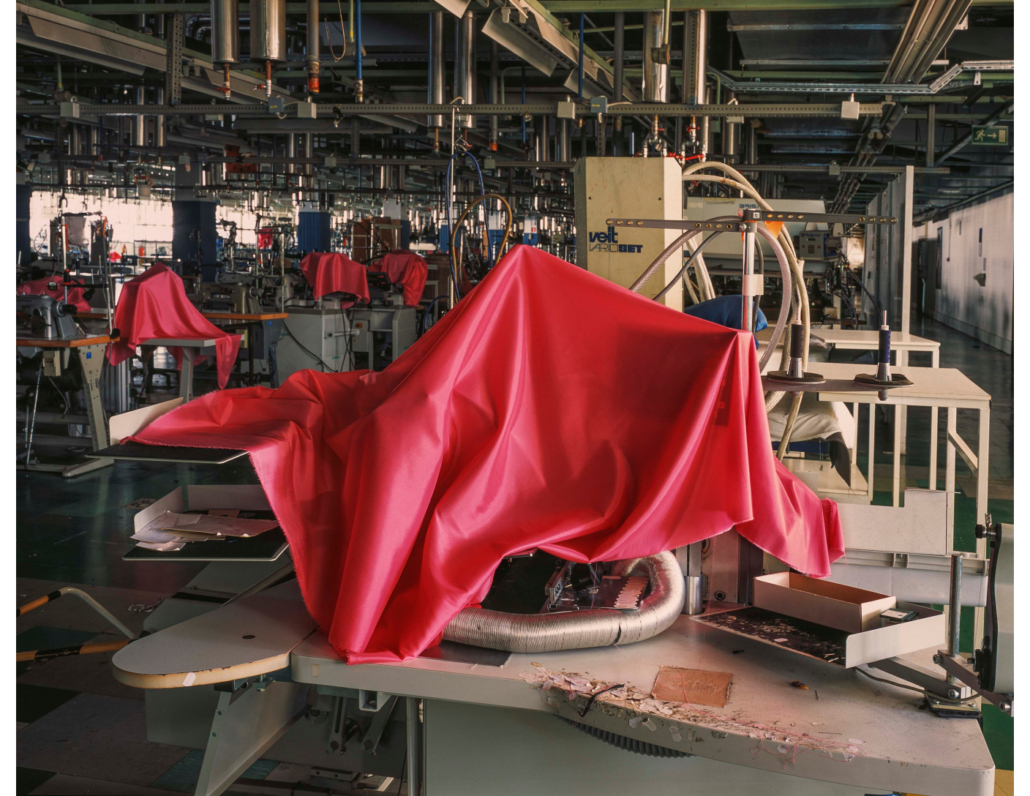
For more than twenty-five years, I have been working with and alongside industrial workers in Slovenia, tracing the long and uneven processes of industrial restructuring and deindustrialization in postsocialist times. What kept troubling me over the years was a persistent gap between industrial workers’ experiences, especially among textile workers, and the way they were (mis)represented in public, politics, and academia. This gap, I argue, reflects how social, political, academic debates, or their absence, have shaped the representation of labour, class, and socialism through an anti-socialist lens. Such representations affected industrial workers’ lives, influencing how their experiences were (mis)recognized or silenced.
To better explain my point, I want to first recall the postsocialist context in Slovenia: a new nation state emerged for the very first time, and the whole political, economic, and social system changed. This transformation began with a powerful promise, but quickly turned into disappointment for many, as inequalities deepened. Not only industrial workers, but also other sectors experienced massive layoffs. Public services were increasingly privatized, including social rights and housing, while norms, values, and social expectations shifted following the neoliberalization of labour markets and calls for the reinvention of entrepreneurial selves. People faced not only material insecurity but also profound existential and ontological uncertainty, as knowledge, meanings, and interpretations were so dramatically transformed.
Yet these problems and experiences were rarely discussed, because major public and academic attention focused on political pluralism, market reforms, democratization, and integration into the European Union, the core elements of the transition scenario. Within this frame, deindustrialization was presented as inevitable and necessary: a natural outcome of economic restructuring and global integration and even framed as essential for national capital accumulation.
Critical perspectives challenging this narrative remained marginal. International scholarship largely overlooked Slovenia, while domestic research tended to focus on other pressing issues, emphasizing economic success, nation-building, or the formation of new political identities. Within this public and academic framing, the social consequences of deindustrialization were not addressed in any systematic way. Yet for my interlocutors, industrial workers themselves, these celebrated success stories only deepened feelings of loss and devaluation. Their experiences reveal the uneven social and regional consequences of transition and point to the importance of critically examining the framing of privatization only in relation to (national) capital accumulation.
With a focus on workers’ experiences, emotions, bodies, affects, and the reorganization or loss of labour, my long-term ethnographic research aimed to question these dominant political and academic framings. I felt the urgency growing, as almost all of the textile factories closed during the time of my research. Sewing machines died silently. Not because the workers were silent, for they were not, but because their words, demands, and claims were routinely misinterpreted or dismissed.
I began to think about silencing as a social and political act. In my most recent research project Ethnographies of Silence (ARRS-RPROJ-JR-2023/68), I focus on the power of such misinterpretations and the ways in which workers’ voices are gradually disqualified. When workers’ demands for recognition of dispossession are labeled as nostalgic grievances, they are routinely dismissed. I term this process nostalgization, where nostalgia is attributed to workers as a form of disqualification and othering. This framing casts their experiences as backward, anti-progressive, or even ideologically wrong, further undermining any claims against structural violence.
At the same time, another layer of silencing emerged through the individualization of experiences, which denied workers the space to articulate trauma, shame, anger, and disappointment. These experiences manifested in their bodies as distress, illness, alcoholism, and, in some cases, even suicide.
Such multi-level silencing revealed the need to reconsider how we, as researchers, frame deindustrialization and industrial workers’ losses. This is why it matters to view deindustrialization through a political-economic lens. Deindustrialization should not be understood merely as a loss, but as a form of structural violence tied to capital accumulation. In Slovenia, this meant the accumulation of capital in the new state, achieved through the disciplining of labour and dispossession. Workers were stripped of their rights, entitlements, and value, along with the material assets they had collectively built during self-managed socialism, which were later appropriated through privatization.
Deindustrialization studies help me see postsocialist experiences not as isolated “postsocialist conditions” but as part of a broader trajectory of capitalist development. They give me a different sense of temporality, showing that the consequences of deindustrialization are long-lasting. This is very important, as it also counters the individualization of social suffering, reminding us that the trauma of deindustrialization is not short-lived but enduring, and not merely individual but structural and collective.
At the same time, comparisons and broader debates should not obscure the specific historical contexts of labour dispossession, including the nuances and intensities of socialist and postsocialist trajectories, the persistence of postsocialist othering, and the continued framing of socialism, even in academia, as a failure. For this reason, a deeper dialogue between deindustrialization studies and postsocialist studies is essential.
So why does it still matter to discuss deindustrialization today? Because these debates put people, class, and power relations on the table. In Slovenia, the normalization and naturalization of deindustrialization was framed as a necessary part of capital accumulation in the new independent state, or as inevitable due to globalization and EU integration. Yet similar dynamics have occurred elsewhere, as documented in extensive literature and Depot research, highlighting the need to challenge the invisibility of structural violence and to recognize the ongoing consequences for the working class. These processes are not confined to the past; their effects continue to shape lives, labour, and social relations in the present and will influence how future reconfigurations unfold, as such framings are deeply embedded in our social, political, and academic worlds. Recognizing them is crucial now as new transitional scenarios for green and just future are being designed. How these transitions are framed reflects an ongoing state-capital pact, signaling that past structural violence remains unacknowledged while continuing to structure violence in the future.
Nina Vodopivec is a social anthropologist and research associate at the Institute of Contemporary History, and an associate professor at the Faculty of Arts, University of Ljubljana. Her work explores labour, gender, the embodied and emotional dimensions of deindustrialization and postsocialist transition, including memories of socialism, factory life, and experiences of work. She is the author of Silencing the Sewing Machines: Experiences of Job Loss and Factory Closure (2021), based on the closure of the Mura garment factory, and is currently involved in the research project Ethnographies of Silence(s), which examines silenced histories and experiences.