
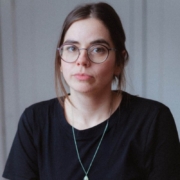
Florence Darveau Routhier conducts her research in the Alexandre district of downtown Sherbrooke, a working-class neighbourhood where revitalization initiatives are part of an ongoing process of displacement. Her place-based research aims to deconstruct the managerial viewpoint that apprehends poverty and related issues “from above” (Scott, 2019). She therefore approaches poverty-related issues and historical struggles as closely as possible, in the ways in which they are experienced, drawing on creative ethnographic methods and epistemologies of situated point of view (Hill Collins, 1997; Haraway, 1988). Her collaborative approach is anchored in practices of mutual aid, popular education and struggles for worthy living conditions. To this end, she uses the archive as a method of research and collaboration. Her postdoctoral project, supported by the FRQSC, involves a collaborative approach to creating a popular archive in downtown Sherbrooke, and aims to document the entangled processes of colonisation and de-re-industrialization, and their effects on living conditions in Sherbrooke. Her SSHRC-funded doctoral thesis is a critical public ethnography describing a context of dispossession in the Alexandre district. She is a member of Collectif d’histoire, d’éducation et d’archivage Populaire (CHEAP).
Research statement: Archiving the lived city: the present history of a Sherbrooke in struggle
My postdoctoral project aims to contribute to the development of a popular archive located in the heart of the Alexandre district – a working-class neighbourhood in downtown Sherbrooke, Quebec, Canada – in collaboration with the Collectif d’histoire, d’éducation et d’archivage populaire (CHEAP) and other local organizations and individuals interested in archiving and involved in the struggles for housing, access to health care for all and status for all. Through this approach, I seek to describe and understand the spatial struggles underway in downtown Sherbrooke and the specific conjuncture in which they are taking shape. In doing so, I also wish to establish the intertwined processes of deindustrialization and gentrification that shape the specific context of Sherbrooke, a university town whose development was organized around the hydraulic power of the Magog River and marked by the textile and metallurgy industries and the cohabitation, for over a century, of English- and French-speaking institutions. My place-based project proposes a dual contribution – social and scientific – by participating in the production and archiving of local, heterogeneous and plurivocal knowledge through a collaborative ethnographic (Rochat, 2021) and creative approach to the archive, and by tracing the entanglements – unseen in the literature – between the cyclical processes of deindustrialization (High, 2022) and gentrification (Lees and Phillips, 2019).
Email: florence.darveau.routhier@umontreal.ca