
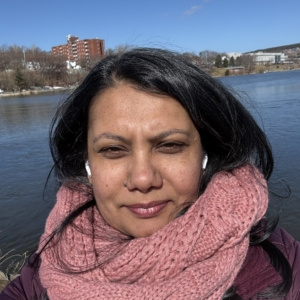
Piyusha Chatterjee is Assistant Professor in the Department of History at Memorial University of Newfoundland, Canada. Her current research investigates gendered and marginalized labour in geographies of the Global South and the impact of deindustrialization and economic restructuring on working-class communities, particularly women, migrant groups and racialized diaspora in the West.
Following a postdoctoral position within the Deindustrialization and Politics of Our Time Project at the University of Glasgow, she was awarded the Leverhulme Early Career Fellowship and the accompanying Lord Kelvin and Adam Smith Leadership Fellowship at the University of Glasgow in 2024 for her project Not Cheap Labour: Women’s Lives in Garment Supply Chains. She has a PhD in Individualized Arts and Social Sciences Program from Concordia University, Montreal. Before moving to Canada, she completed her MA and BA (Hons) degrees in India between 1999 and 2004 and worked in print journalism and oral history for ten years.
In addition to deindustrialization studies, her research and teaching interests span the fields of oral and public history, and the Global South.
Piyusha is a long-time member and core affiliate of the Centre for Oral History and Digital Storytelling at Concordia University.
Project Statement:
The project “Not Cheap Labour: Women’s Lives in Garment Supply Chains” investigates the lives, struggles and history of women termed “cheap labour” in the wake of deindustrialization and global economic restructuring. In particular, the focus is on women in the garment and textile industries. The project engages with the changes in the garment industry in the context of broader shifts in the global economy since the 1960s that have led to factory closures in the developed West and relocation of production to developing economies or to home-based and informal work by women within the developed regions. My objective is to co-create a narrative of women workers’ experiences based on oral histories, cultural representations and policy analysis. Considering women workers as both shaping and being shaped by the world around them through processes that crystalize on different scales, the project foregrounds the following research questions: What kind of historical transformation has the industry undergone? How has gendered difference helped produce cheap labour for the industry? How do women negotiate, resist or fight forces that draw on their waged and unwaged labour for profit? What do the stories of these women contribute towards the understanding of gendered labour in the economy? And how do women’s experiences from the Global South complicate the understanding of transnational politics of the spatial division of labour?


 Source: Store Norske Leksikon