
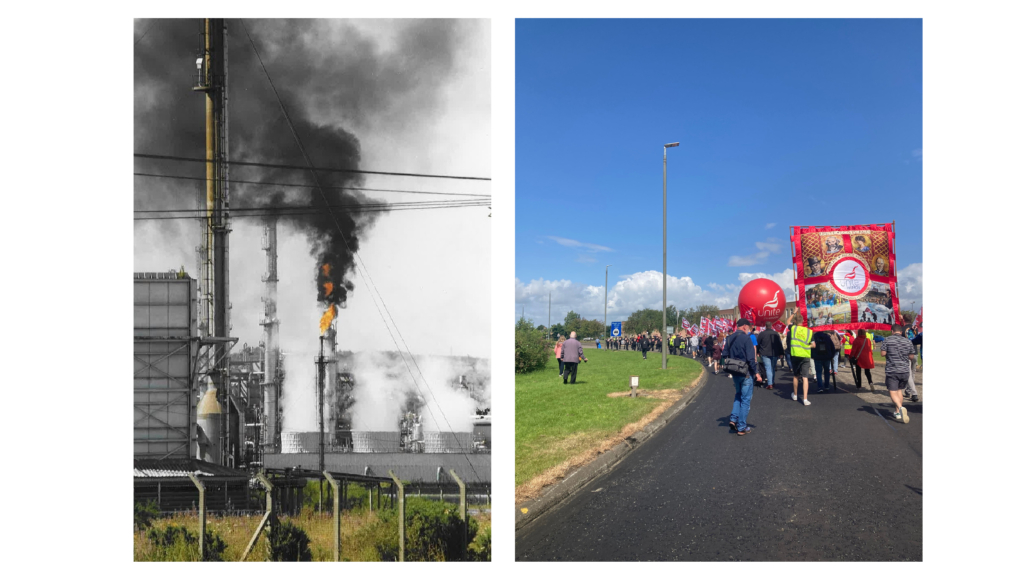
By Riyoko Shibe
In 2021, in its vision for a green, just future, the Scottish government committed itself to learning from the ‘recent and painful experience of unfair and unplanned transitions’ which had pervaded Scotland in the 1980s: it stated, ‘our former coal-mining communities still bear the scars of rapid, unplanned change. That cannot happen again.’[1]
The warning was prescient. Only four years later, Scotland’s last refinery in Grangemouth, owned by Petroineos, shut, with devastating job losses. This was socially and environmentally mismanaged: the Scottish and UK governments failed to save the complex and protect jobs, while the refinery’s conversion into a fuel import terminal entrenched noxious hydrocarbon connections.
At the beginning of 2024, a few months after the refinery closure was announced, I interviewed Euan,[2] a young Grangemouth worker. Our interview coincided with the 40th anniversary of the miners’ strike in March 1984. Euan told me that though the miners’ strike was before his time,
You’re well aware when you’re growing up of the impact that that had on our communities … You watch some of the documentaries on TV at present [about the miners’ strike] and you’re actually gobsmacked at the similarities.
Euan’s historically informed warning comparing the injustice faced by refinery workers and that faced by the coal miners of the 1980s—also a key message in the subsequent trade union campaign to save the refinery that emerged later in 2024—[3]reflected the mass unemployment and socioeconomic decline facing Grangemouth as well as oil and gas communities across Scotland.[4]
But in Grangemouth, there have been key distinctions to the story of the collieries. Though unplanned, deindustrialisation has not been rapid, and, unlike coal which ended in closure, has lacked a singular point of departure. Grangemouth’s story has been one of survival. When deindustrialisation was triggered in 1970, its petroleum industry grew but was coupled with contracting employment. This phenomenon has been described by academic scholarship as ‘noxious deindustrialisation’.[5] Even the refinery closure does not signal an end. Job losses coupled with investment into fossil fuel infrastructure marks the entrenchment of noxious injustice.
In early 2023, I interviewed Alistair Laird, a refinery worker who began his employment at the complex when he was thirty years old in 1985, retiring in 2015. Reflecting on the future of Grangemouth before the closure was announced, Alistair lamented,
There’s nothin on the horizon for the replacement of what’s been lost in Grangemouth. Grangemouth’s lost so much, I mean even doon tae the woodyards in the old town, they’re no longer there, they no longer manufacture, they don’t handle the goods that they used to.
Alistair’s observation underscored a long trend of injustice and loss endured by the locality over several decades. In 1997, The Herald labelled the town ‘the heart of darkness’ in 1997, reporting on cancers and respiratory diseases experienced by residents.[6] In an academic study undertaken in the early 2000s, Schlüter et al. described Grangemouth as a ‘doom town … in crisis’.[7] It was this air of malaise that Lorenzo Feltrin, Alice Mah and David Brown entered when they undertook their fieldwork in Grangemouth in 2018 and developed the concept of ‘noxious deindustrialisation’. They observed in their interviews ‘frustration and decline’ and the fear that Grangemouth had become ‘Scotland’s dumping ground.’[8]
My PhD research, though, has underscored positives in Grangemouth’s story since the 2000s, the result of a strong trade union presence. In 2008 and 2013, workers at Grangemouth struck over threat to their terms and conditions. Stuart started working at Grangemouth in 2012, the year before the second of these strikes, and though he had other options on the table, he underscored that the terms and conditions at Grangemouth—the legacy of trade union campaigning—made it the most appealing option. Stuart explained, ‘I could see what they [the union] were actually fighting for because it was one of the main reasons I came here.’
The experience of injustice expressed by Feltrin et al. and Schlüter et al. was reflective of a growing bifurcation between those who could attain jobs at the complex and reap relative economic security, and those who could not. This was the result of noxious deindustrialisation, which saw fewer people employed in the settlement’s industry. Ian Peattie drew attention to this widening socioeconomic gap in his oral history testimony. Ian was born in Grangemouth in 1945 and described the settlement as ‘a town of two halves, really. You’ve got the affluent half, and within a stone’s throw of the refinery you’ve got the most deprived areas in Scotland.’
Ian’s reflections underscore a town marked by major distinctions in wealth, a sentiment echoed by Ellie, a young university graduate from Grangemouth and whose dad had worked at the complex. She explained that ‘I could only come to uni [sic] because my dad worked in INEOS as a welder and he had a stable income.’ Through the refinery, she continued, ‘if you’re in the have nots you can become the haves … [go] from, like, the poverty line, to live in what I would consider a middle-class lifestyle’. In a town experiencing significant levels of socioeconomic deprivation, the refinery was a lifeline, severed when refining in Scotland came to an end in 2025.
In Grangemouth, the Scottish and UK governments have failed to learn from the ‘rapid, unplanned change’ of the coal mines. But this neglect predated the closure, with Grangemouth enduring decades of injustice at the hands of noxious industry. In the absence of government support, the fight for better work has been led by organised labour, and though injustice has become more pronounced since 2025, this struggle has continued. The union at Grangemouth has fought tooth and nail to protect refinery jobs, and where this failed, successfully fought for redundancy packages,[9] a conditionality where firms accessing just transition funding must prioritise former Grangemouth workers,[10] and lobbied the government to deliver on stated promises for the complex.[11] At the centre of their campaign is a just transition, a worker-centred struggle for a prosperous, green future for all.
[1] The Scottish government. “Just Transition – A Fairer, Greener Scotland: Scottish Government response,” 7th September 2021, 11. https://www.gov.scot/publications/transition-fairer-greener-scotland/pages/1/ (Accessed 16th November 2025).
[2] Name has been changed. Participants named by forename alone indicate a pseudonym, while full names indicate non-anonymised participants.
[3] https://www.unitetheunion.org/campaigns/oil-and-gas-no-ban-without-a-plan
[4] Other closures included the Port Talbot Steelworks (Wales) in 2024, the Lindsey oil refinery (England) in 2025, and the Mossmorran ethylene plant (Scotland) in 2026, as well as the threatened closure of the Scunthorpe Steelworks (England) in 2025, and thousands of job losses estimated to be lost in the North Sea. See https://theconversation.com/uk-oil-and-gas-workers-risk-becoming-the-coal-miners-of-our-generation-239262
[5] Shibe, Riyoko. “Petrochemicals, Pollution, and the Moral Economy of Noxious Industry: Grangemouth, Scotland, from 1951 to 1989”, Enterprise & Society 26, no. 3 (2025): 1057–84; Feltrin, Lorenzo, Alice Mah, and David Brown. “Noxious Deindustrialization: Experiences of Precarity and Pollution in Scotland’s Petrochemical Capital.” Environment and Planning C: Politics and Space 40, no.4 (2022): 950-969.
[6] https://www.heraldscotland.com/news/12317254.the-heart-of-darkness/
[7] Achim Schlüter et al., “Enough Is Enough: Emerging ‘Self-Help’ Environmentalism in a Petrochemical Town”, Environmental Politics 13, no. 4 (2004): 718.
[8] Feltrin et al., “Noxious Deindustrialization,” 957.
[9] https://www.dailyrecord.co.uk/news/politics/hundreds-grangemouth-refinery-workers-agree-34979372
[10] https://www.gov.scot/news/supporting-grangemouth-workers-2/
[11] https://www.unitetheunion.org/news-events/news/2025/august/grangemouth-workers-launch-open-letter-over-starmer-broken-promises