
Deindustrialization studies generally focus on the social and cultural consequences of industrial decline in the Global North from the 1950s onwards. They mostly probe the responses of private firms, unions, and national governments to the global phenomenon of industrial decline. Attempting to extend this research agenda, my current work investigates the urban and spatial causes of deindustrialization (1). Inspired by historians, geographers, and sociologists like Robert D. Lewis, Tracy Neumann, Joel Rast, and Sharon Zukin, I am particularly interested in the role of urban administrations in regulating manufacturing activities in central cities, often in ways that weakened industrial land use and jobs (2).
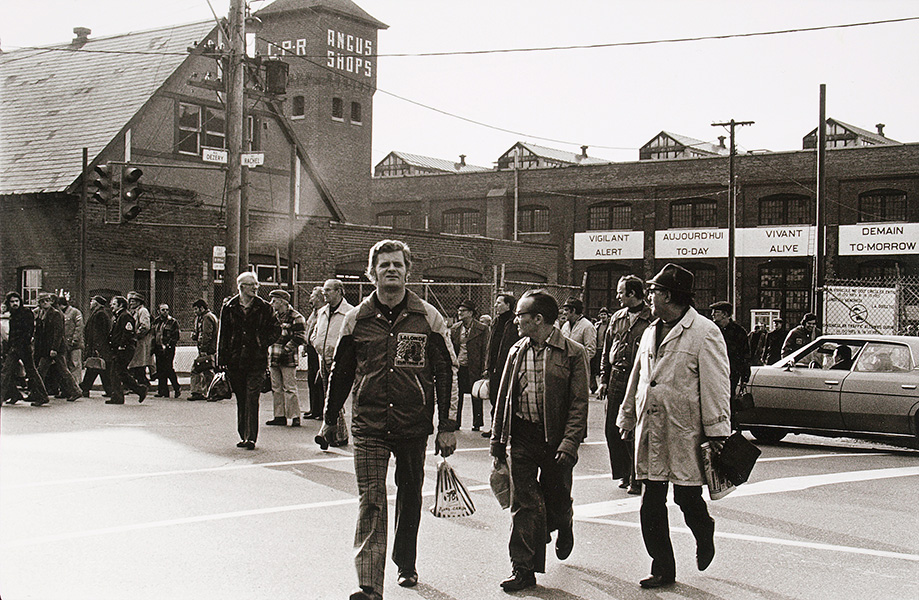
Montréal, located in the Canadian province of Québec, is a great place to study the historical role of urban administrations in shaping deindustrialization trajectories — and Steven High’s Deindustrializing Montreal is an unavoidable stepping stone (3). Beyond prominent causal factors like industrial offshoring and suburbanization, its particular historical context structured its fierce deindustrialization pathway. First, its industrial mix was heavily dependent on low-productivity sectors like textile and clothing, increasing its vulnerability to international competition (4). Second, the affirmation of francophone nationalism in 1960s and 1970s Québec fostered the exodus of English Canadian capital away from the city, undermining its industrial base. Third, Canada’s economic center of gravity shifted westward during the 20th century, favouring the likes of Toronto, which surpassed Montréal in the Canadian urban hierarchy during the 1970s. The ramifications of these changes have been tremendous: while there were close to 150,000 manufacturing jobs in the City of Montréal in 1961 (30% of the labour force), there are only 39,000 left 60 years later (4%). Deindustrialization has profoundly affected the city’s landscape and social mix.
Between 1960 and 1994, Montréal’s political history was marked by two long-lasting yet contrasted urban regimes in power at city hall. This singular situation allows for an in-depth assessment of the influence local officials and city bureaucrats have exerted onto urban industrial capacity, since they’ve had multiple electoral mandates to implement their urban industrial agenda. Through economic development and spatial planning tools, they have produced differentiated and contrasted urban industrial policies. My ongoing research on Montréal, based on municipal archives and oral history interviews with former civil servants, city councillors, community organizers, trade unionists, and blue-collar workers, finds evidence of three different urban-industrial regimes — which I define as coalitions of local government and nongovernment actors loosely aligned towards a certain urban industrial agenda.
The first urban-industrial regime, from 1960 to 1978, was shaped by the powerful figure of right-of-center mayor Jean Drapeau — in continuous power between 1960 and 1986. Obsessed by megaevents and spectacle, he obtained the organization of the 1967 International Exhibition and the 1976 Olympic Games in Montréal (5). Attuned to real estate and show business interests, he attempted to use megaevents to affirm the city’s international status and accelerate its tertiarization. He devoted meagre city resources towards industrial support, while competing North American cities and suburbs were creating modern industrial parks along highways. His urban-industrial regime undermined the city’s traditional industrial base and fostered the depopulation of central working-class neighbourhoods.
The second urban-industrial regime, from 1979 to 1986, was steered by high-level technocrats, who were largely in charge of strategic vision and administrative tasks while mayor Drapeau, still in power but weakened by corruption scandals and cost overruns in the run-up to the 1976 Olympics, stuck to public relations. Figures like Yvon Lamarre, president of the city’s executive committee during that period, attempted to tackle demographic and industrial decline in old neighbourhoods. To do so, they created a city division (CIDEM) and an urban development corporation (SODIM) tasked with industrial retention and expansion through the construction of modern industrial parks and grant programs for existing factories. However, suffering from limited resources and administrative dispersion, they could not decisively alter industrial decline.
The third urban-industrial regime stemmed from the Montreal Citizens’ Movement (MCM) party, which beat Drapeau’s party in the November 1986 municipal elections and governed until 1994. This left-of-center party promoted heritage preservation, neighbourhood development, and environmental quality. In principle, it favoured industrial retention in traditional manufacturing areas and attempted to pacify urban-industrial tensions by creating the 1992 master plan. However, its eclectic nongovernment coalition allies tore the MCM in opposite directions. Community groups and trade unions advocated for industrial support and the protection of manufacturing districts, which the MCM supported by acquiring and renovating industrial buildings. Yet real estate and business elites pushed a strong postindustrialist agenda that disregarded the importance of industrial capacity while hyping up the service sector. Suffering from irreconcilable demands, the MCM’s urban industrial policy was further restricted by the tough financial context of the early 1990s recession, limiting its effectiveness.
In conclusion, my research argues that deindustrialization scholars need to further interrogate both the urban and spatial causes of industrial decline in the Global North. Here, I have insisted on the role of urban administrations in favouring or constraining industrial capacity in cities. Elected officials, local civil servants, and their coalition partners form urban-industrial regimes. Depending on the composition of their electoral base and on the historical context, they produce differentiated and contrasted urban industrial policies, with long-lasting consequences on cities and their inhabitants.
1. For published articles, see: Clarence Hatton-Proulx, « Explaining infrastructural bifurcation: A comparative history of urban incineration in Montréal and Paris », Journal of Urban Affairs 0, no 0 (2025): 1‑23; Clarence Hatton-Proulx, « Comprendre la fermeture de l’incinérateur des Carrières: le rôle des changements sociaux et politiques dans la désindustrialisation des environnements urbains », Urban History Review/Revue d’histoire urbaine 54, no 1 (2026).
2. Robert D. Lewis, Chicago’s Industrial Decline: The Failure of Redevelopment, 1920–1975 (Cornell University Press, 2020); Tracy Neumann, Remaking the Rust Belt: The Postindustrial Transformation of North America (University of Pennsylvania Press, 2016); Joel Rast, Remaking Chicago: The Political Origins of Urban Industrial Change (Northern Illinois University Press, 2002); Sharon Zukin, Loft Living: Culture and Capital in Urban Change (Johns Hopkins University Press, 1982).
3. Steven High, Deindustrializing Montreal: Entangled Histories of Race, Residence, and Class (McGill-Queen’s University Press, 2022).
4. Lauren Laframboise, « “La Grève de La Fierté”: Resisting Deindustrialization in Montréal’s Garment Industry, 1977–1983 », Labour / Le Travail 91 (2023): 57‑88.
5. Matthieu Caron, Montreal After Dark: Nighttime Regulation and the Pursuit of a Global City (McGill-Queen’s University Press, 2025).