By Steven High
The Regent Knitting Mill in Saint-Jérôme, located fifty miles north of Montreal, closed its doors in June 1974. It was a massive mill with 1,500 textile machines, comprising 395,000 square feet of floor space in 45 buildings. In fact, it was Eastern Canada’s only integrated textile and clothing manufacturing plant.
Fully 23% of Quebec’s manufacturing workforce were in clothing and textiles as compared to 8% in Ontario, making the province especially vulnerable to trade liberalization.
Media reports at the time invariably identified the former owners by name, the anglophone Grover family, and the fact that they lived in Westmount (a rich anglophone enclave of Montreal0 – thus linking Regent Knitting to a wider Quebec nationalist concern about Anglo-capital and the exploitation of French-Canadian workers. Newspapers highlighted how the local union had been locked into a decades long struggle with the owners, including regular strikes, lockouts, and even a plant occupation.
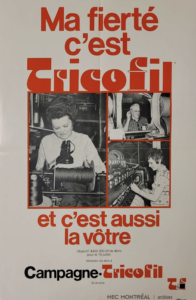
This long history of class conflict provided the basis for the unionized workers’ decision to reopen the mill under worker ownership, first renting the premises and then purchasing it, with the help of a province-wide fundraising campaign. Led by Lise Payette, a Quebec television personality, the campaign, which included the included la Fédération des travailleurs et travailleuses du Québec (FTQ)’s Fernand Daoust, transformed “Tricofil” into a nationalist cause celebre.
Payette famously declared that « la libération du Québec passe par Saint-Jérôme’» (the liberation of Quebec runs through Saint-Jérôme).
It wasn’t the first worker buyout in deindustrializing Quebec. The most celebrated case was the worker buyout of the paper mill in Temiscaming in 1972 after forcing the departing multinational company to sell the closed mill. It took a blockade of the Ottawa River by fishing boats, which prevented the company from floating its logs down river past the town to another mill, as well as pressure from government, to convince it to sell. Tembec quickly established itself as a success, though the mill finally closed its doors last year – a half century later.
From the start, les tricofiliens of Saint-Jérôme sought to control the company they owned. Tricofil’s board of directors consisted mostly of workers and only workers had voting shares. Foremen were eliminated and in their place a system of “premièr homme” and “première femme” (first man, first woman) was instituted without the right to punish their fellow workers.
There were regional sales fairs, including at colleges, where students flocked to buy worker-designed and produced clothing. And fashion shows featuring workers in the clothing they made were a big hit.
Dozens of newspaper articles spoke of the euphoria of the early days when Tricofil workers were now “leurs propres maîtres” (their own masters). It was an experiment that fit the times.
The FTQ, at the highest levels, was also deeply involved in Tricofil. Jean-Guy Frenette, the FTQ’s economist, even served as its president. Several key figures in the Parti-Québécois (PQ) also joined the effort including Pierre Marois, a lawyer, who represented Tricofil, who took great pleasure in threatening to sue the president of the Conseil du Patronat du Québec for slander, after he dared to call Tricofil a “moral crime” as it raised false hope amongst a desperate workforce and community.
The election of the PQ under René Lévesque in November 1976 was a key moment as many of Tricofil’s biggest supporters were now in cabinet. They included Lise Payette, Pierre Marois, and Bernard Landry. Together these three cabinet ministers formed an interministerial committee responsible for Tricofil within the new government.
Given its symbolic value to the new Quebec taking shape, Jacques Couture, a worker-priest, and new Minister of Labour, chose to visit Tricofil as his first act as minister after the election. He told the assembled workers that day that their experience “était un exemple d’un nouvel esprit qui anime de plus en plus les travailleurs, de gens qui ont le goût de se prendre en main, et de trouver eux-mêmes les solutions. » (was an example of the new spirit that animates more and more workers, people who have the taste of taking things in hand, and to find their own solutions). He went on to say that it was “un exemple de la manifestation des Québécois à vouloir se prendre en main » (an example of the manifestation of Quebecers to take things in hand).
We can see here how the workers’ efforts to save their jobs fed into the wider nationalist narrative.
Bit by bit, the PQ government subsidized Tricofil as it lurched from one financial crisis to the next. Bernard Landry called Tricofil “un laboratoire économique et social, » (an economic and social laboratory) and one does not close a laboratory. Lise Payette even threatened to resign from cabinet unless the government agreed to another round of massive public subsidies. More public money was handed over.
However, consultant reports revealed considerable mis-management at Tricofil, forcing the government to insist on fundamental changes in governance and self-management as well as the restructuring of its operations including the layoff of half of the remaining workforce as the company concentrated on the textile side of the business.
Ultimately, Tricofil was killed by the recession of 1981. By then, the unfolding agony at Tricofil had made worker ownership political poison in Quebec. As journalist Jacques Forget noted: « Tricofil est d’abord et avant tout une aventure politique. » ( Tricofil was above all political adventurism)
Considered a spectacular failure, the Quebec labour movement henceforth turned away from worker buyouts when faced with plant closings. Instead, it favoured the creation of labour-led venture capital funds like le Fond de solidarité which gave trade unions a seat at the restructuring table.
This blog is part of a book that I am slowly researching and writing that explores Quebec’s response to deindustrialization during the 1970s and 1980s.