



Aparna Das reflects on the complexity of Kolkata’s culture and built environment
Yuan Yi uses the case of Orinoka Mills to explore the impacts of American textile closures
Joseph Coates and Emiliano Aguilar discuss the work done to preserve the memory of ACME workers in the Calumet region after the company’s coking plant closure.
Amber Ward reviews Netflix’s Toxic Town, a depiction of women’s response to the continued exploitation of residents in a deindustrialized English town.
Noah Schwartz discusses the whitewashing that occurs in many cases of historical preservation of gentrifying deindustrialized neighbourhoods, using the example of Marysville, New Brunswick
Nearly 150 researchers and students are currently affiliated with the DePOT project. Historians and sociologists abound. Yet there are only a few scholars trained in planning or geography.
As urban planning scholars based in Detroit—specializing in community development and economic development respectively—we have affiliated with the DePOT project because studying deindustrialization challenges us to reconsider one of the foundational relationships structuring the built environment: the linkage between jobs and communities. Specifically, deindustrialization draws our attention to the decisive role that industry has long played in creating—and subsequently remaking—neighborhoods, cities, and metropolitan areas.
Nearly 150 researchers and students are currently affiliated with the DePOT project. Historians and sociologists abound. Yet there are only a few scholars trained in planning or geography.
As urban planning scholars based in Detroit—specializing in community development and economic development respectively—we have affiliated with the DePOT project because studying deindustrialization challenges us to reconsider one of the foundational relationships structuring the built environment: the linkage between jobs and communities. Specifically, deindustrialization draws our attention to the decisive role that industry has long played in creating—and subsequently remaking—neighborhoods, cities, and metropolitan areas.
Nearly 150 researchers and students are currently affiliated with the DePOT project. Historians and sociologists abound. Yet there are only a few scholars trained in planning or geography.
As urban planning scholars based in Detroit—specializing in community development and economic development respectively—we have affiliated with the DePOT project because studying deindustrialization challenges us to reconsider one of the foundational relationships structuring the built environment: the linkage between jobs and communities. Specifically, deindustrialization draws our attention to the decisive role that industry has long played in creating—and subsequently remaking—neighborhoods, cities, and metropolitan areas.
Between January and May this year, more than 260,000 U.S. federal government workers have either been laid off, taken early retirement, or accepted buyouts. Thousands more are losing jobs as the Trump administration slashes research grants and funding for social services and non-profits. While the cuts affect people across the country and the world, they hit especially hard in Washington, D.C., where the federal government has always been the largest employer. As the Axios news service put it, the Trump administration is “downsiz[ing] the capital city’s big factory.”




The info package and preliminary program for DePOT’s 2023 conference is now available! You can read it here.
Registration for the conference is also open on Eventbrite.
If you have any questions or concerns, please email deindustrialization@concordia.ca.
Last updated: February 23, 2023 to correct a typo. To make sure that you’re consulting the most up-to-date version of the program, visit our conference page.


The final program for the Transnationalizing Deindustrialization Studies conference this August 17-20 is now available! The program includes key information on our upcoming international conference, including schedules for public roundtables, regional industrial heritage tours, and a two-day academic conference.

The preliminary program for DePOT’s Transnationalizing Deindustrialization Studies conference is now available. The inter-disciplinary conference will be taking place in the Ruhr in Germany from August 18-20.
Dr. Novoa’s socially engaged scholarship focuses on the intersections of cultural heritage and social justice, industrial heritage and gender, and the politics of memory and grassroots organizing in Chile.
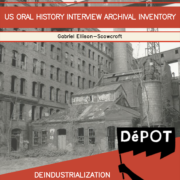
The “US Oral History Interview Archival Inventory” compiles oral history interview collections related to deindustrialization in the United States. This report brings together collections from libraries, archives, museums, and educational institutions, and is intended to support research into the lived experiences of deindustrialization, as well as encouraging the use of existing oral history collections in future research.

The Department of History, Heritage and Classics at Swansea University has just announced a fully-funded 3-year PhD fellowship for an incoming UK-based student studying deindustrialization. Click through for more information.

We’ve just finished laying out the first of our published research reports! This one is an inventory of oral history interview archives located in the UK, put together by student affiliate James Ferns.
The first Annual Report for Deindustrialization and the Politics of Our Times has just been published. Click through to read it.

We’re very pleased to announce that the first episode in our Deindustrialization and the Politics of Our Time podcast series, an intro to DePOT with Principal Investigator Dr. Steven High, is now live and ready for listeners.


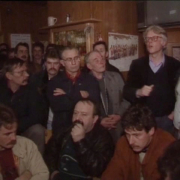 Photo: Alusuisse workers meet in Steg, January 1993 (Schweizer Fernsehen DRS, 27.1.1993
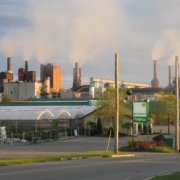 Bouchecl, Wikimédia, Creative Commons Attribution-Share Alike license
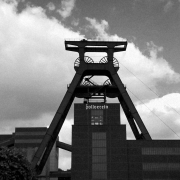 Zollverein World Heritage Site. Essen, Germany. Photo: Sebastian High.
 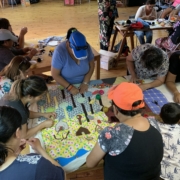 Women from the ex-coal mining town of Lota working on a collaborative arpillera urbana (textile art) depicting the history of their town. Photo by Magdalena Novoa.